
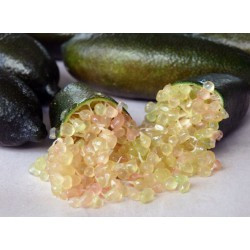
The finger lime (Citrus australasica), also known as caviar lime, is an Australian citrus with fruits the size of a finger. Inside are tiny pearls of juice that pop in your mouth, like caviar. In this guide we explain what it is, how to use it in the kitchen, how to store it and how to look after a finger lime tree so you can pick your own fruit.
Quick answer: the finger lime is the fruit of a thorny shrub from the forests of eastern Australia. Its juice vesicles, round and firm, are very sharp, similar to lime, and are used to add acidity and texture to fish, seafood, salads, desserts and cocktails. The tree grows well in a pot or in the garden, in sun, in free-draining soil rich in organic matter, and tolerates only light frosts. A grafted plant starts fruiting at around three years old.
In this article
1. What is a finger lime?
It is a citrus native to the rainforests of north-eastern New South Wales and south-eastern Queensland, in Australia. For many years it was called Microcitrus australasica; today it is classified in the genus Citrus, the same as the lemon and the orange.
- Plant: a large shrub or small tree, which can reach 6 metres in the wild. In cultivation, its size depends a great deal on the rootstock: there are trees of about 1.5 m and others of large size.
- Leaves and thorns: small leaves and many thorns, up to 2.5 cm long, practically one in every leaf axil.
- Fruit: elongated, a few centimetres long, with green, yellow, pink, red or almost black skin. When opened, out come the juice vesicles, which keep their round shape.
- Flavour: very sharp, like a lime, with notes of lemon and grapefruit.
2. What it is used for and how to use it
It is a restaurant garnish and the perfect accompaniment to cocktails. The secret is the texture: instead of juice that spreads, it has pearls that deliver acidity in little bursts and a touch of colour.
- Cut the fruit in half across, or make a cut lengthways.
- Squeeze with your fingers from the closed end: the pearls come out on their own.
- Add at the last moment, on the plate or in the glass, so they do not break up.
- Fish and seafood: oysters, fish carpaccio, salmon, ceviche, sushi.
- Starters and salads: with avocado, fresh cheese or tomato.
- Desserts: on ice cream, a panna cotta, a lemon tart or red berries.
- Drinks: in a gin and tonic, a sparkling wine or a sparkling water.
Use it as you would lime zest or juice, but sparingly: half a fruit is enough for several dishes.
3. How to store finger limes
Contrary to what you often read, a very cold fridge is not the best place. The fruit suffers chilling injury and that about 10 °C is the most suitable temperature: at that, it keeps for up to three weeks, plus one to two weeks at room temperature. If you have a less cold salad drawer or a cool larder, that is the best choice.
4. Varieties and colours
The plant is practically the same in every variety; what changes is the colour of the skin and the pearls and a hint of flavour. There are varieties with green, yellow, pink and red flesh (for example 'Pink Ice' and 'Rubirosa', with pink pearls, and 'Maroon Gem', with red pearls).
Our shop has more than fifteen finger lime varieties, with green, yellow, white, pink and red pearls, such as Mia Rose, Judis Everbiring, Pink Ice and Red. A practical tip: if you have room for two plants, choose different colours; on the plate, a mix of green and pink pearls is the one that impresses most.
5. How to plant and care for the tree
| Care | What to do |
|---|---|
| Light | Sun or bright partial shade. |
| Soil | Free-draining, rich in organic matter and slightly acidic. In a pot, citrus compost. |
| Watering | Regular, letting the top layer dry out between waterings. It does not tolerate waterlogged roots. |
| Cold | Tolerates light frosts, but a frost-free spot is ideal. In colder areas, give it shelter in winter. |
| Planting | In spring, once the risk of frost has passed. |
| Feeding | Citrus fertiliser, with magnesium and trace elements, from spring to late summer. |
| Pruning | Very little. At the end of winter, remove dead branches and any growing below the graft. Wear thick gloves. |
In Portugal, the finger lime is happy wherever the lemon tree is happy. On the coast and in the south it can stay in the ground; in inland areas with frequent frosts, it is safer in a pot, moved against a sheltered wall or under a porch on the coldest nights. Where winters are colder still, as in most of Britain, treat it as a pot plant: it tolerates only light frosts, so in winter keep it somewhere bright and sheltered, and water less often.
There is no official minimum temperature. All that is established is that it tolerates "light frosts". The figures that circulate online come from nurseries and vary widely; if hard frost is forecast, protect the plant.
6. Finger lime in a pot
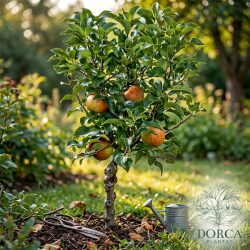
This is one of the best ways to grow it, especially on balconies and in cold areas. It grows slowly, has small leaves and, grafted onto a suitable rootstock, stays compact.
- Pot: start with a pot slightly larger than the root ball and move up a size in spring, when roots come out of the drainage holes. Avoid moving straight into a much bigger pot, which leaves the compost waterlogged.
- Compost: citrus compost, with about one fifth coarse grit or gravel for drainage.
- Winter: in a bright, sheltered spot, with less frequent watering. If you live somewhere colder than Portugal, this is the point that matters most, because the plant tolerates only light frosts.
See also our selection of fruit trees for pots and our guide on when and how to prune a lemon tree, which applies to all citrus.
7. When it fruits
- Grafted plant: starts fruiting at around three years old, but the bigger crops only come at around six.
- Seed-grown plant: can take 5 to 15 years to fruit and does not always come true to the parent.
- Season: in a Mediterranean climate in the northern hemisphere, it flowers from February to April and carries fruit throughout the year, peaking in November and December. In Portugal, expect the main harvest in autumn and winter; elsewhere it depends on your climate.
The fruit is ripe when the skin takes on the colour of its variety and gives slightly to the touch. It often falls on its own. Pick carefully because of the thorns.
In summary
- An Australian citrus with very sharp, lime-like pearls of juice.
- Added at the end, over fish, seafood, salads, desserts and drinks.
- Keeps at about 10 °C for up to three weeks; intense cold spoils it.
- Likes sun, free-draining rich soil, and tolerates only light frosts.
- Grafted, it starts fruiting at around three years old.
8. Frequently asked questions
What does a finger lime taste like?
Very sharp, like a lime, with notes of lemon and grapefruit. What sets it apart is the texture: the pearls pop in your mouth.
Why are finger limes so expensive?
Picking is done by hand and is difficult because of the thorns, each fruit is small and it keeps for only a few weeks after picking. A tree at home, after a few years, gives more fruit than most people would buy.
Does a finger lime need another plant to fruit?
There is no technical confirmation either way. Nurseries describe it as self-fertile, and a single plant usually fruits. If you have room, two varieties add more colour to the harvest.
Can it live indoors?
It prefers to be outdoors, in sun. Indoors, only by a very bright window and for short periods, such as winter in cold areas.
Does it have thorns?
Yes, many and sharp. Wear gloves for picking and pruning, and choose a spot away from where children play.
Finger limes in our shop


Sources
- Australian Native Plants Society, "Citrus australasica": anpsa.org.au
- Australian National Botanic Gardens, "Citrus australasica": anbg.gov.au
- NSW Department of Primary Industries, "Growing Australian native finger limes" (Primefact 979): dpi.nsw.gov.au
- UC Riverside, Citrus Variety Collection, "Finger lime" and the 'Rubirosa' and 'Maroon Gem' varieties: citrusvariety.ucr.edu
- UC ANR, "Finger limes" (Topics in Subtropics): ucanr.edu
- Frontiers in Horticulture (2026), storage of finger limes: frontiersin.org
- Royal Horticultural Society, "Citrus: grow your own": rhs.org.uk