
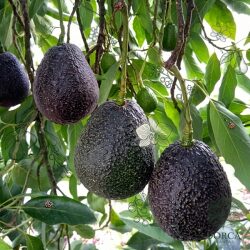
Almost everyone has put an avocado stone in water to see what happens. But if you want avocados at home, the right question is a different one: how to grow an avocado tree that bears fruit. In this guide we explain the difference between an avocado grown from a stone and a grafted one, which varieties stand up to cold, how to plant and why watering is the care that matters most.
Quick answer: plant a grafted avocado tree, in the sun, in very free-draining soil, in spring after the last frost (from March to June in Portugal). A grafted tree gives its first avocados 3 to 4 years after planting; one grown from a stone takes many years longer and the fruit may not match the parent tree's. Where there is frost, choose more cold-hardy varieties such as Bacon or Fuerte; Hass is one of the most sensitive. Do not overwater: it is the main cause of root rot.
In this article
1. Avocado from a stone or grafted?
Germinating a stone is a good experiment, especially with children, but it rarely leads to an orchard. A tree grown from seed takes many years longer to fruit than a grafted one (the figures vary widely), and a stone does not necessarily reproduce the variety it came from: the fruit may be different.
A grafted avocado tree joins two plants: below, a rootstock chosen because it resists root diseases better; above, the variety, chosen for its fruit and its tolerance of cold. Expect the first avocados 3 to 4 years after planting a grafted tree.
| From a stone | Grafted | |
|---|---|---|
| First fruit | many years, unpredictable | 3 to 4 years after planting |
| Fruit | may differ from the original | that of the chosen variety |
| Roots | no choice | rootstock chosen for root diseases |
| Cold | unpredictable | that of the variety (see the next table) |
2. Which variety to choose: cold and A and B types
In Portugal, the choice starts with cold, and in a colder climate it matters even more. This is the cold limit of each variety; an established tree can withstand temperatures of 0 to −2 °C for short periods:
| Variety | Flower type | Stated cold limit |
|---|---|---|
| Bacon | B | about −4.4 °C |
| Zutano | B | about −4.4 °C |
| Fuerte | B | about −2.8 °C |
| Hass | A | about −1.1 °C |
| Lamb Hass | A | about −1.1 °C |
| Pinkerton | A | about −1.1 °C |
The exact figures can vary by a degree or two, but the order is always the same: Bacon and Zutano are the hardiest, then Fuerte, and Hass is one of the most sensitive. In Portugal, inland where there are frosts, start with Bacon; on the coast and in the Algarve, Hass does well.
A and B types: the avocado flower opens first as female and then as male, on different days. In type A varieties (Hass, Lamb Hass, Pinkerton, Reed, Gwen) this happens in one order; in type B varieties (Fuerte, Bacon, Zutano), in the reverse order. Pairing an A with a B helps pollination, but in a garden bees and wind are enough: a second tree is not essential.
3. When and where to plant
- When: after the last spring frost, once the soil has warmed: from March to June. These are the months for Portugal's climate; they shift with your region.
- Sun: full sun.
- Wind: a sheltered spot; wind and temperature extremes affect flowering and fruit set.
- Soil: the most important thing is drainage. In heavy soil, or soil that waterlogs, plant on a mound (a raised heap of soil).
- Space: the avocado becomes a large tree: leave it room to grow.
4. How to plant, step by step
- Dig a hole the size of the pot. There is no need to improve the soil in the hole.
- Check the drainage: fill the hole with water and see whether it drains. If water stands, plant on a mound.
- Handle the root ball carefully: avocado roots are sensitive. Set the pot in the hole and only then cutting it away.
- Plant at the same depth as it was growing before, with the graft above the soil.
- Water well straight away.
- Mulch the soil with coarse wood chips, leaving about 15 cm clear around the trunk.
5. Watering, mulch and feeding
Do not overwater. Overwatering is one of the main causes of root rot in avocados. Let the soil drain between waterings and do not water soil that is already wet.
- Mulch: 10 to 15 cm of coarse wood chips under the canopy, kept away from the trunk. It helps hold moisture and keep the roots healthy.
- Feeding: in several small applications rather than one large one.
- Pruning: an avocado tree needs little or no pruning.
6. Root rot and rootstocks
Root rot (Phytophthora cinnamomi) is the most important disease of the avocado, and it is worse in poorly drained soils. Correct watering is the most important practice to prevent it, together with good drainage and a wood chip mulch.
The rootstock helps too. Some rootstocks are more tolerant of root rot, including Dusa and Duke 7, though none is immune. In our shop there are avocado trees grafted onto both of these rootstocks, such as the Hass on Dusa and the Hass on Duke 7.
7. When it fruits and how to pick
A grafted avocado tree starts to fruit 3 to 4 years after planting. Each variety flowers for about two months.
The avocado has one peculiarity: it does not ripen on the tree. It is picked when mature but still firm, and softens afterwards, in 7 to 10 days at room temperature.
In summary
- Grafted: fruit in 3 to 4 years; from a stone, many years longer, and the fruit may differ.
- Where there is frost, Bacon or Fuerte; Hass is one of the most cold-sensitive.
- Plant from March to June (in Portugal), in sun, in very free-draining soil.
- Water without overdoing it, and mulch with coarse wood chips under the canopy.
- Rootstocks such as Dusa and Duke 7 tolerate root rot better.
8. Frequently asked questions
How long does an avocado tree take to fruit?
Grafted, 3 to 4 years after planting. From a stone, many years longer, and not always with good fruit.
Do I need two avocado trees to get fruit?
It is not essential. In a garden bees and wind are enough for pollination. One type A tree and one type B tree can help.
Can an avocado tree survive frost?
It depends on the variety. Bacon and Zutano are among the hardiest, at around −4 °C; Hass is one of the most sensitive, close to −1 °C. Young trees need protection from frost.
Can I grow an avocado tree in a pot?
A pot is one way to shelter it from frost in its first years, which matters most where winters are cold, but remember that it is a tree that wants to grow. In our shop there are avocado trees already in 25-litre pots.
Grafted avocado trees in our shop


Read also seasonal fruit in Portugal and see all our tropical and subtropical fruit trees.
Sources
- UC Master Gardeners of San Luis Obispo County, "Avocado: a unique fruit": ucanr.edu
- UC IPM, "Avocado: Phytophthora root rot": ipm.ucanr.edu