

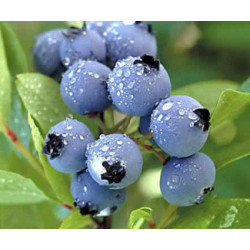
The blueberry is one of the easiest soft fruits to grow at home, as long as you follow one rule: acidic soil. That is why growing blueberries in pots so often works better than planting them in the garden. In this guide we explain how to grow blueberries step by step, which variety to choose for your climate and how to be picking fruit from the third year.
Quick answer: blueberries need acidic soil, with a pH between 4.5 and 5.5, light and rich in organic matter. In a pot, use ericaceous compost with pine bark, in a pot at least 30 cm across that you move up to 45 to 50 cm over time. Plant between autumn and early spring, in sun, water with rainwater whenever you can and feed with an ericaceous fertiliser. Two different varieties side by side give more fruit, and bigger fruit.
In this article
1. The secret: acidic soil (pH 4.5 to 5.5)
Blueberries want soil with a pH between 4.5 and 5.5. It is a critical factor. In chalky or neutral soil, the plant cannot take up iron, the leaves turn yellow and it barely grows.
Blueberries also need soil that is light, airy and very rich in organic matter. Avoid clay soils, which waterlog and suffocate the fine roots, and dig in wood chips or pine bark. If you want to plant in the ground and do not know your soil's pH, test it first: it is cheap and saves years of frustration.
Why pots work so well: in a pot you control the soil completely. In a garden with chalky soil, correcting the pH is slow (sulphur has to go on six months before planting) and the soil tends to go back to what it was.
2. Which variety to choose for your climate
Cultivated blueberries fall into groups, and the main difference between them is how much winter cold they need, counted in hours below 7 °C between December and February:
- Northern highbush (such as 'Duke', 'Bluecrop', 'Chandler'): need a lot of cold: more than 800 hours for 'Duke', one of the most widely planted varieties in Portugal. They are the choice for areas with cold winters.
- Southern highbush (such as 'O'Neal', 'Biloxi', 'Sunshine Blue'): need little cold and suit areas with mild winters. They flower early, so in Portugal the north and inland areas have restrictions on this group: late frosts scorch the flowers.
- Rabbiteye (Vaccinium virgatum or ashei, such as 'Pink Lemonade'): cope better with heat and prefer a slightly lower pH (4.2 to 5.0). They almost always need another variety from the same group to set fruit.
| Variety | Group | Chill needed | Best for |
|---|---|---|---|
| Duke | Northern highbush | more than 800 hours | cold-winter areas; early |
| Bluecrop | Northern highbush | high (the group needs around 800 hours or more) | cold-winter areas; mid-season |
| Chandler | Northern highbush | high (the group needs around 800 hours or more) | cold-winter areas; mid-season, large fruit |
| O'Neal | Southern highbush | 200 to 300 hours | mild-winter areas |
| Biloxi | Southern highbush | low (figures vary between 150 and 300 hours) | mild-winter areas |
| Sunshine Blue | Southern highbush | low | mild-winter areas; compact, good in pots |
| Pink Lemonade | Rabbiteye | less than northern highbush | warm areas; pink fruit; plant with another rabbiteye |
Not sure how many chill hours you get? A rule of thumb: if your winter brings frost every week, choose northern highbush; if it hardly ever freezes, southern highbush. So if your winters are colder than Portugal's, northern highbush is the group to look at. If in doubt, talk to us before you order.
3. How to grow blueberries in pots
- Choose the pot. At least 30 cm across for a young plant and 45 to 50 cm for a mature one. For large varieties, 57 to 76 litres, or half a barrel. Drainage holes are a must.
- Prepare the compost. Use ericaceous compost (the kind for camellias and azaleas). In trials, a mix of coir, pine bark and perlite gave about 1.4 kg of blueberries per plant in the second year. Never use chalky garden soil.
- Plant at the same depth as the plant sat in its original pot, without burying the base of the stem.
- Mulch the surface with 5 cm of pine bark: it holds moisture and helps keep the compost acidic.
- Water well, ideally with rainwater.
- Put it in the sun, sheltered from strong wind. In very hot areas, shade during the hottest hours helps stop the pot overheating.
Bear one thing in mind: in a pot, the plant stays smaller and crops less: about half the harvest of a plant in the ground. In return, it fits on a balcony and you control everything else. See more fruit trees for pots.
4. How to plant blueberries in the ground
If your soil is acidic and light, blueberries do very well in the garden. Dig a wide planting hole, mix the soil with pine bark or other acidic organic matter and plant at the same depth as in the pot. On clay soils, plant on a ridge (a raised mound of soil) so the water drains away. Leave about a metre between plants if you want a small hedge.
When to plant: while the plant is dormant, between mid-autumn and early spring. In Portugal, autumn has the advantage of the rains, which help the plant root before the heat.
5. Watering and hard water
Blueberry roots are fine and shallow: they cannot cope with drying out completely or with waterlogging. Water regularly, especially in pots and in summer, without leaving water standing in the saucer.
Water quality matters as much as the soil. Tap water is often alkaline and, over time, raises the pH of the compost; so use rainwater, with tap water only when there is nothing else. For the crop, the water should have a pH between 5.0 and 5.5 and conductivity below 1.0 dS/m; test it before setting up a plantation.
If your water is hard: save rainwater for watering; keep an eye on the new leaves (if they turn yellow with green veins, the pH has risen); and, in a pot, replace the ericaceous compost when that happens.
6. Feeding
Blueberries struggle to take up nitrogen in nitrate form and prefer the ammonium form. So use an ericaceous fertiliser or, in the ground, ammonium sulphate or urea. One caveat: if the soil pH is already below 5.0, choose urea over ammonium sulphate, which acidifies further.
Feed from spring into summer and stop after July, as is done in commercial plantations. In pots, use a liquid ericaceous feed every two or three weeks during the growing season. Always follow the doses on the pack: in a pot, too much fertiliser burns the roots.
7. Pruning and the first years
In the first years, the priority is the plant, not the fruit. Remove all the flowers in the first year and leaving only half in the second; from the third year on, the plant can crop freely. It is hard to do, but it is what makes a strong bush.
Prune in winter, while the plant is dormant (between December and February; late February or early March is ideal). On a mature bush:
- remove dead and broken branches and those crossing in the centre;
- cut one or two of the oldest stems down to the ground, as they crop little and give smaller fruit;
- let a few new stems grow to replace them. The ideal balance is a minority of new stems and of old stems, with most of them four to six years old.
8. When blueberries fruit and when to pick them
Expect the first proper harvest from the third year and full cropping at around seven years. A mature plant gives between 2.25 and 5 kg.
In Portugal, outdoors, the harvest runs from May to August; it can start at the end of April and continue into September, with southern highbush first and northern highbush and rabbiteye from June. These are the months for Portugal's climate: elsewhere they change with the region. Blueberries do not all ripen at once: pick every few days, taking only the fully blue ones.
More fruit with two varieties: most varieties crop on their own, but cross-pollination gives more fruit set, and larger fruit, so plant two or, better, three different varieties from the same group. With rabbiteyes, cross-pollination is practically essential.
9. Common problems
- Yellow leaves with green veins: the pH has risen (chalky soil or hard water). Correct the compost and the water.
- Plant wilting although the soil is moist: overwatering, which brings root rot (Phytophthora); 'Bluecrop' and 'Duke' are more susceptible and 'Legacy' less.
- The blueberries disappear before you pick them: it is the birds. A light net over the plant, as the fruit starts to ripen, solves it.
- Soft, punctured fruit: it may be Drosophila suzukii, a fly that is a key pest. Pick often and do not leave ripe fruit on the plant.
In summary
- pH between 4.5 and 5.5: in a pot, ericaceous compost with pine bark.
- Northern highbush for cold winters; southern highbush for mild winters.
- A 30 cm pot to start with, 45 to 50 cm for a mature plant.
- Rainwater whenever possible; ericaceous fertiliser, without nitrates.
- Remove the flowers in the first year; proper crops from the third.
10. Frequently asked questions
How long does a blueberry take to fruit?
It may give a few berries in the first or second year, but remove those flowers so the plant can grow. The proper harvest starts in the third year and peaks at around seven.
Do I need two blueberry plants?
It is not essential for most highbush varieties, but two different varieties from the same group give more fruit, and bigger fruit. With rabbiteyes such as 'Pink Lemonade', yes: they need another rabbiteye nearby.
Why are my blueberry's leaves turning yellow?
Most of the time the pH is too high, because of chalky soil or hard water: the new leaves turn yellow with green veins. If the whole leaf yellows and the soil is always soggy, the problem is watering.
Can I use garden soil in the pot?
No. Garden soil is almost always too heavy and not acidic enough for blueberries. Use ericaceous compost.
Can a blueberry cope with the cold on a balcony or patio?
Northern highbush varieties not only cope with it, they need winter cold to flower well. In a colder country, that makes them the group to choose. The things to watch are a waterlogged pot and, with southern highbush, late frosts once they are in flower.
Blueberry plants in our shop


Fond of soft fruit? See all our soft fruit, from raspberries to currants, and the calendar of seasonal fruit in Portugal.
Sources
- INIAV, P. Brás de Oliveira, "Good practice manual: blueberry" (Manual de boas práticas: mirtilo): iniav.pt
- COTHN, "Growing blueberries" (Produzir mirtilos): cothn.pt
- Oregon State University Extension, "Growing blueberries in your home garden" (EC 1304): extension.oregonstate.edu
- Oregon State University, "Nutrient management for blueberries in Oregon" (EM 8918): extension.oregonstate.edu
- Royal Horticultural Society, "Blueberries: grow your own": rhs.org.uk
- UC Master Gardeners of Santa Clara County, "Blueberry varieties": ucanr.edu
- Portuguese Nutrition Association, "National Production Calendars" (Calendários de Produção Nacional, 2021, with GPP and COTHN): apn.org.pt