
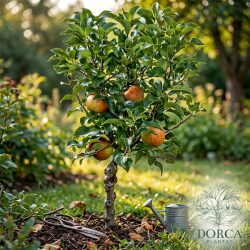



A lemon tree in a pot gives you lemons on a balcony, a terrace or a patio, and it has one advantage over a tree in the ground: it can be moved when the cold arrives. To care for a lemon tree in a pot, everything that happens inside the pot counts: its size, free-draining compost, watering and feeding. In this guide we explain each one.
Quick answer: choose a small-growing variety, such as the Meyer lemon, and pot it on gradually up to a final pot of about 60 litres or a half barrel. Use citrus compost with about one fifth coarse grit or gravel, in a pot with drainage holes. Water when the top 5 to 7 cm of compost is dry, feed from spring to summer with a complete citrus fertiliser, and in winter water less and shelter it from frost.
In this article
1. Which lemon tree to choose for a pot
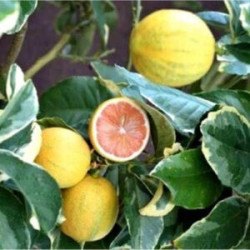
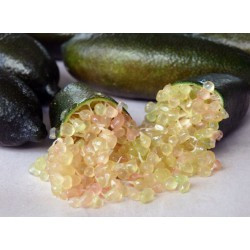
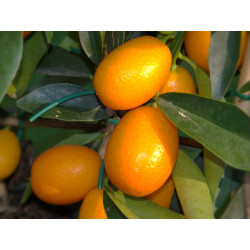
Start with a tree that does not want to be big. For containers, choose naturally small species: the Meyer lemon, mandarins and kumquats. The Meyer has another advantage: it takes more cold than the common lemon (see section 8).
The rootstock matters too. 'Flying Dragon' is the only truly dwarfing citrus rootstock, keeping the tree between 1.2 and 2.4 metres. If the plant's description gives the rootstock, it is worth reading.
In our shop there are lemon trees already in pots, such as the lemon tree in a 10-litre pot and the Meyer lemon in a 10-litre pot, and our collection of fruit trees for pots.
2. The pot: size and drainage
There are two rules that look contradictory but are not:
- The final pot is large. For most varieties, use a half barrel or a container of at least 15 US gallons, about 57 litres.
- You get there gradually. Move into a pot only slightly larger when roots start to come out of the drainage holes, preferably in spring: a much larger pot all at once can cause problems.
Wide drainage holes are essential. If the pot stands in a saucer, empty it after watering: citrus roots cannot cope with sitting in water.
3. The compost
Use a specialist citrus compost or a loam-based compost, mixed with about 20% coarse grit or gravel to improve drainage. The aim is a compost that holds moisture but lets excess water drain away quickly.
Avoid heavy garden soil and very fine composts, which compact with watering. Over time, compost loses its structure: when you pot on, take the chance to refresh the compost around the root ball.
4. How to plant, step by step
- Choose the right time: spring, once there is no longer any risk of frost. Planting citrus in spring avoids the cold while the plant settles in.
- Prepare the pot: only slightly larger than the root ball, with drainage holes.
- Mix the compost: citrus compost with about one fifth coarse grit or gravel.
- Plant at the same depth as it was growing before, with the graft point well above the compost.
- Water slowly until water runs out of the holes, and let it drain.
- Put it in the sun, somewhere sheltered from strong wind.
5. Where to put the pot
A lemon tree wants sun and light. Lack of light is one of the reasons citrus fail to flower. A south- or west-facing balcony, or a sunny patio, is ideal. Shelter it from strong wind and draughts, which make the leaves turn yellow and drop.
A lemon tree in a pot can change places over the year. If you move it, do it gradually: sudden changes in light and temperature also make leaves drop.
6. Watering
In a pot, watering is the care that matters most, and the most common mistake is overwatering. The rule is simple: water when the top 5 to 7 centimetres of compost are dry, and water slowly. Push a finger into the compost before you water.
- Spring and summer: keep the compost just moist and use rainwater where possible. At the height of summer, a pot in the sun dries out much faster: check the compost more often.
- Winter: water less often, keeping the compost on the dry side, and never leave the pot standing in water.
Yellow leaves? Overwatering is one of the most common causes. See our guide lemon tree yellow leaves: causes and what to do.
7. Feeding
In a pot, the plant only has the nutrients you give it. For citrus in containers, use a slow-release fertiliser mixed into the compost or a liquid feed once or twice a month, always complete, with trace elements.
Timing matters: the tree needs the most nitrogen from flowering until June, and feeding should stop in mid-August so as not to push out shoots that the cold will scorch. For citrus grown in pots in the UK, a common recommendation is a high-nitrogen summer citrus feed from late March to October and a more balanced feed from November to mid-March; others prefer not to feed in winter. We explain it all in our guide citrus feed: which fertiliser, when and how much.
8. Winter
This is where the pot makes the difference. Most citrus suffer when the temperature drops below −2.2 °C for more than a few hours, and the 'Eureka' lemon is frost-sensitive. The Meyer is one of the hardiest: protect it below about −6.7 °C.
- On the Portuguese coast and in the south: the pot can stay outdoors all year, against a sheltered wall on the coldest nights.
- Inland and wherever frosts are common: move the pot into a porch, a cold greenhouse or a bright, cool room when frost is forecast.
- Indoors: for a lemon tree spending a British winter indoors, the recommended night-time minimums range between 5 and 10 °C. Give it light, little water, and no draughts or hot air blowing straight onto the plant.
If your winters are colder than Portugal's, the pot is what makes a lemon tree possible: plan for it to spend the winter in a bright, cool, sheltered place, with less watering. In spring, move it back outdoors gradually, first into bright shade and then into the sun.
9. Pruning and fruit
In a pot, pruning keeps the tree's size and shape in check: light cuts every year, in February or March. We explain how in our guide when and how to prune a lemon tree.
Do not let the tree carry too much: a plant about one metre tall should not carry more than twenty fruits at once. And do not be surprised if many tiny fruits drop after flowering: it is normal for the tree to shed many of them, or even most.
In summary
- Meyer lemon, mandarin or kumquat are the easiest citrus for pots.
- Pot on gradually up to about 60 litres; always use drainage holes.
- Citrus compost with one fifth coarse grit or gravel.
- Water when the top 5 to 7 cm dry out; less in winter.
- Complete fertiliser from spring to mid-August; shelter from frost.
10. Frequently asked questions
What size pot does a lemon tree need?
To begin with, a pot only slightly larger than the root ball. Over the years, a mature tree needs a large container: at least 57 litres, or a half barrel.
How often should I water a lemon tree in a pot?
There is no fixed number: water when the top 5 to 7 cm of compost is dry. In hot summer weather that will be much more often; in winter, much less.
Can a potted lemon tree live indoors?
It can spend the winter indoors in a bright, cool spot, but it does better outdoors, in the sun, from spring to autumn.
When should I repot my lemon tree?
When roots start to come out of the drainage holes, preferably in spring, into a pot only slightly larger.
Why is my lemon tree in a pot not producing lemons?
The most common causes are lack of light, lack of feeding, irregular watering and cold. Very young trees do not crop yet either.
Lemon trees for pots and citrus feed in our shop


Sources
- UC Master Gardeners of Santa Clara County, "Citrus": ucanr.edu
- Royal Horticultural Society, "Citrus: grow your own" and "Citrus problems": rhs.org.uk
- University of Florida IFAS, "Meyer lemon": gardeningsolutions.ifas.ufl.edu
- UC Cooperative Extension Placer and Nevada Counties, fertilising citrus: fruitsandnuts.ucdavis.edu