
A lemon tree with yellow leaves is telling you something is wrong, but the cause is not always the same. The good news is that the way the leaf turns yellow says a lot: whether it is the old leaves or the new ones, whether the veins stay green, whether the leaves drop. In this guide we show you how to read the signs and what to do in each case.
Quick answer: evenly yellow old leaves usually mean lack of nitrogen, often only in winter, when the soil is cold and wet. Yellow new leaves with green veins point to lack of iron, common on chalky soil. A yellow patch shaped like an upside-down V on mature leaves is lack of magnesium. Leaves that turn yellow and drop while the soil is always wet mean overwatering; draughts and cold do the same.
In this article
1. Quick diagnosis from the leaf
| What you see | Likely cause | What to do |
|---|---|---|
| Old, lower leaves evenly yellow | Lack of nitrogen (or cold, waterlogged roots in winter) | Feed in spring; wait for warmer weather |
| New leaves yellow or whitish, veins green | Lack of iron (zinc or manganese give similar signs) | Iron chelate applied to the soil; correct the soil and the water |
| Mature leaves with a yellow upside-down V patch, tip and base green | Lack of magnesium | Magnesium sulphate or a fertiliser with magnesium |
| Yellow leaves that drop, soil always wet | Overwatering | Water only when the top 5 to 7 cm dry out |
| Yellow leaves and leaf drop after cold or a move | Cold, draughts, sudden change | Shelter; avoid sudden changes |
| Curled leaves with silvery trails | Citrus leafminer | On mature trees, usually nothing |
| Sticky leaves or a black, sooty coating | Aphids or scale insects (honeydew and sooty mould) | Cut off the ants' route; control the pest |
| New leaves with pits and distortions | African citrus psyllid (in affected areas) | Confirm and follow the official rules |
2. Yellow old leaves: lack of nitrogen
When the yellowing starts on the oldest leaves and spreads across the whole leaf, the most likely sign is lack of nitrogen: a general yellowing of the foliage, starting with the oldest leaves.
Before you feed, check the time of year. Citrus roots take up nitrogen poorly in cold, wet soils: that is why many lemon trees look yellowish at the end of winter and turn green again in spring without anything being done. Feeding in the depths of winter does little good.
What to do: feed with a complete citrus fertiliser from late February or March, split into several applications until mid-August. Rates and timing are in our guide citrus feed: which fertiliser, when and how much.
3. New leaves with green veins: lack of iron
If the new leaves are pale yellow or almost white and the veins stay green, iron chlorosis is the most likely cause. It is very common on chalky (calcareous) soils: the iron is in the soil, but the plant cannot take it up. Most citrus orchards in the Algarve are on calcareous soils, and chlorosis is corrected with iron chelates applied to the soil, such as Fe-EDDHA.
- Apply iron to the soil, not the leaves. Applying iron to the leaves is not effective; chelates applied to the soil work better, though not always.
- Zinc and manganese give similar signs, with yellowing between the veins on new leaves. Most growers have to apply zinc every year, as a spray on the new shoots.
- In a pot, hard (calcareous) water gradually raises the pH of the compost: replace the compost and use rainwater when you can.
4. Yellow upside-down V patch: lack of magnesium
Magnesium deficiency has a pattern of its own: yellow patches beside the central vein of mature leaves, which grow until only the tip and base of the leaf stay green, in an upside-down V. It appears mainly near the fruit, because the tree draws magnesium from the leaves to feed them.
What to do: correct it with magnesium sulphate (Epsom salts) or magnesium oxide. To prevent it, use a citrus fertiliser that contains magnesium, such as the formulas with "Mg".
5. Leaves that yellow and drop: watering, cold and light
When leaves turn yellow and drop with no clear pattern, look at watering first. Overwatering is a typical cause of yellow or falling leaves, as are draughts, low temperatures and lack of feeding.
- Watering: water only when the top 5 to 7 cm of soil are dry. In a pot, never leave water in the saucer.
- Cold: after a frost, scorched leaves turn yellow and drop. Do not prune straight away: wait for the spring shoots to see what is still alive.
- Light and moves: a lemon tree brought indoors for the winter can lose leaves from the lack of light and the change in temperature.
Some leaf drop is normal. The lemon is evergreen, but it renews its leaves gradually. A few yellow old leaves in an otherwise green canopy with new shoots are no cause for alarm.
6. Pests that change leaf colour
- Citrus leafminer: tiny larvae that tunnel silvery trails through new leaves and leave them curled. On mature trees the damage is mainly cosmetic and treatment is unnecessary.
- Aphids and scale insects: they leave a sticky honeydew on which a black fungus grows, sooty mould, which blocks light from the leaf. Ants protect them: a sticky band around the trunk helps.
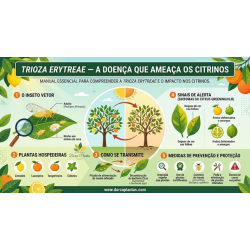
- African citrus psyllid (Trioza erytreae): its feeding leaves pits and distortions on new leaves, and it prefers lemon trees. In Portugal, the DGAV (the national plant health authority) has demarcated zones for it, with rules for anyone who grows citrus there. Find out more in our guide to the African citrus psyllid.
Greening (HLB) is not present in Portugal. The most feared citrus disease in the world is absent from Portugal, confirmed by survey. Yellow leaves on your lemon tree almost always have one of the causes above.
7. How to prevent it
- Water well, but not too much: only when the top of the soil has dried.
- Feed at the right time: a complete citrus fertiliser, with magnesium and trace elements, from late winter to mid-August.
- Look after the soil: good drainage; with chalky soil or hard water, expect to need iron.
- Give light and shelter: sun, and protection from frost and draughts.
- Check the new leaves every week in spring, when pests appear.
In summary
- Evenly yellow old leaves: nitrogen (or cold, waterlogged soil in winter).
- New leaves with green veins: iron, especially on chalky soil; iron to the soil, not the leaves.
- Upside-down V on mature leaves: magnesium; magnesium sulphate.
- Yellow and dropping: too much water, cold or draughts.
- Trails, honeydew or pits: leafminer, aphids and scale insects, or psyllid.
8. Frequently asked questions
Do yellow leaves turn green again?
Leaves that turn yellow from lack of nitrogen in winter usually recover in spring. Very yellow or frost-scorched leaves usually drop and are replaced by new ones.
Are Epsom salts good for a lemon tree?
Yes, when magnesium is lacking: Epsom salts are magnesium sulphate, the right correction. They do not correct a lack of nitrogen or iron.
Can I spray iron on the leaves?
Applying iron to the leaves is not effective. Iron chelates applied to the soil work better.
My lemon tree in a pot turned yellow after I brought it in for the winter. Is it serious?
Often it is the lack of light, the change in temperature or too much water. Give it the brightest, coolest spot you have, water less and wait for spring.
To correct and prevent it, from our shop



Read also lemon tree in a pot: how to care for it and when and how to prune a lemon tree.
Sources
- UC Cooperative Extension Placer and Nevada Counties, citrus nutrition: fruitsandnuts.ucdavis.edu
- UC Master Gardeners of Santa Clara County, "Citrus": ucanr.edu
- University of Florida IFAS, magnesium deficiency in citrus (HS141): ask.ifas.ufl.edu
- M. Pestana, University of the Algarve, iron chlorosis in citrus: researchgate.net
- Royal Horticultural Society, "Citrus problems": rhs.org.uk
- UC IPM, "Citrus leafminer": ipm.ucanr.edu
- DRAP Centro, technical sheet on Trioza erytreae: ccdrc.pt
- EPPO, distribution of Candidatus Liberibacter asiaticus: gd.eppo.int